





General Information
Duration: 4 min 33 sec
Genres: Animation, Short
Language:
Country:
Submitted By: Danilo Del Tufo
Festival Rating 8.5
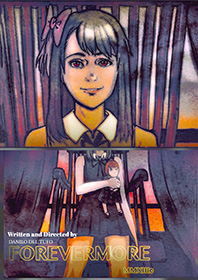
Written and Directed by Danilo Del Tufo.
Synopsis: "The story is inspired by the clinical case of Anton Boisen, an American chaplain. In particular about his reflections on the role of his family as he attempted to write a treatise about his faith during his mental illness."
-
DirectorsDanilo Del Tufo
-
ProducersDanilo Del Tufo
-
WritersDanilo Del Tufo
-
Film TypeAnimation, Short
-
Genres
-
Runtime4 minutes 33 seconds
-
Production BudgetUSD
-
Country of Origin
-
Country of Filming
-
Film Language
-
Shooting Format
-
Aspect Ratio
-
Film ColorColor
-
Student ProjectNo
-
First-time FilmmakerNo
Director's Statement
For the short film "Forevermore," which is an original work, I drew inspiration from several sources:
The story depicts chaplain Anton Boisen's desire to have a family, which develops during the writing of his treatise on faith.
1) "The Vain Flight from the Gods" (Italian title), English title "On Paranoia, 1986; On the Necessity of Abnormal Psichology; Ananke and Athena" by James Hillman
2) "On the Fourfold Root of the Principle of Sufficient Reason" by Arthur Schopenhauer
3) "The Spirit of ’43", Walt Disney Company
Let me give you an example:
"It is impossible to think anything without a fantastic image..." (Aristotle, De Anima III)
This refers to the Meta-Narrative Space, where the eidolon are represented, that is, the images that
appear on the surface and have a "ghostly" resemblance to the original ones.
This intersubjective attitude will lead us to question them, forcing us to go beyond their representation.
The Zeitgeist of post-Nazi Germany is a space of meta-narrative. What I'm referring to is a sort of cultural extinction, where the cult of National Socialism, is disappeared today, but still present in collective unconscious.
For this reason, I chose to draw inspiration from the clinical case of Anton Boisen, an American Presbyterian pastor who lived between the two world wars (1876–1965), which is reflected in the role of the girl and the man.
While he was trying to write his Profession of Faith, he had this idea: "Suddenly, with terrible force, this idea invaded my mind, that the weak and the imperfect are for the perfect, and the weak for the strong...that the family must consist of four and not two,
the strong and the perfect, and the guardian angels...together, a curious pattern emerged, which I mechanically wrote down and continued to repeat, as as if I were learning a lesson: a four-part scheme with the weak, the strong, the perfect, and the imperfect.
The impression was extraordinary, and I felt as if I had been seized and transported to another world." Anton Boisen never married. He was born in 1876 and died in 1965, therefore he lived between the two world wars.
Anton Boisen's delusions offer a parallel to those that were fundamental to the cult of the Aryan race in the Third Reich, and to the genocide that ensued, but from the perspective of a rigid family structure.
By this I mean that between the “I" of the discourse that names the subject and the experienced I there exists a fracture (Ichspaltung) that on the one hand separates the subject from itself,
and on the other generates itself.
The story therefore centers on a family, composed of a husband, wife, and two daughters.
The parallel with the Boisen case led me to the analogy of the Nietzschean myth of the superman, and consequently is a reference to the implicit need and failure of “…I can’t paint one main scene for the Greater Germany" (ibid.), by the Wife simply in Filmic Space, and indeed this allows us to enter a meta-textual language.
The name Priscilla means "Very Ancient..." and indicates the zeitgeist, the spirit of the times, this too is represented by the temporal suspensions of the distant sea scenes (Elegy of the Journey, Sokurov).
With this difficult passage, I refer to Boisen's theme of religious delirium, in which the entire story is a representation of man's inner crisis,
which initially moves from the perspective of the personal unconscious with a certain symbolic force, then reaches the operation of the collective unconscious through the clouding of reason, but without eluding the space of meta-narrative and consequently that of the cinematic.
This phenomenon corresponds to an unconscious process of loss that is typical of cultural extinction, and manifests itself in the vision of ghosts as in Sokurov's "Oriental Elegy" (the Japanese elders seen as ghosts and the loss of tradition in modernization), or in Kubrick's The Shining (Priscilla and the other girl holding hands).
The resulting trauma in the man produces a family trauma of undeniable power, which implies the lack of reference figures, and the concept of the "disappearance" of emotional figures.
Starting from Carl Gustav Jung's concept of "Anima and Animus," female figures are the unconscious sum of our own figures that accompany the structuring of the unconscious.
The man uses this figure of Priscilla, but it's unclear whether it's all a hallucination or how he resolves the "family of four." It's an image that manifests itself, but it lives a symbolic life of its own.
So we can say that Priscilla is the daughter, meaning "Very Ancient...", an archaic reminiscence of the desire to structure his family as perfect with four people (archetype).
Finally, Priscilla recites "Forevermore," because we've witnessed something that's an unconscious vision, a sort of borderland where we're unsure whether to decipher the theme of death, or to see the whole story as a dream of a man simply trying to defend the memory of his family, once balanced within the idea of the quadripartite schema, in his socio-cultural environment that his personal and then collective unconscious has reawakened (on the television, a Donald Duck whose eye sockets are the symbol of Nazism). This leads us to the idea that there exists a mental image of a bygone era that the protagonist, along with the viewer, relives.
Best Regards,
Danilo Del Tufo