





General Information
Duration: 1 hr 49 min 0 sec
Genres: Documentary
Language:
Country:
Submitted By: Prithwish Roy
Festival Rating 8.8
-
DirectorsPrithwish Roy
-
ProducersPrithwish Roy
-
ProducersSabita Nandi
-
VideographerTapas Dharmapal
-
EditorSukrit
-
MusicKankan Bhattacharya
-
Film TypeDocumentary
-
Genres
-
Runtime1 hours 49 minutes 0 seconds
-
Production BudgetUSD
-
Country of Origin
-
Country of Filming
-
Film Language
-
Shooting Format
-
Aspect Ratio
-
Film ColorColor
-
Student ProjectNo
-
First-time FilmmakerNo
Dhaka International Cultural Film Festival
Bangladesh
Dhaka
02/11/2024
Dhaka International Cultural Film Festival
Best Docyumentary
Movie Mind
India: All Rights
India: All Rights
Director's Biography
Prithwish Roy was born in Kolkata, the foremost city for cultural movement in India, in the year of 1963.
He is engaged in Bengali theatre movement since childhood. Author of the drama 'Chithibabu' which was performed in major auditoriums in Kolkata. Scripted, directed and acted in several audio-dramas, the CD of which was also published.
He learned still photography and participated in various national and international salons. His works won several awards. Fédération Internationale de l'Art Photographique honored him as AFIAP. His still photos were used as permanent backdrop in News programs in Doordarshan, Kolkata.
He is engaged in cine society movement.
He completed Diploma on video film direction. Three scripts of him were selected and telecast in 'Rang-Tamasha' program in Doordarshan, Kolkata. He has, so far, made three short films - Dirty Mind!, Toy, About Universe - which were accepted in several international film festivals.
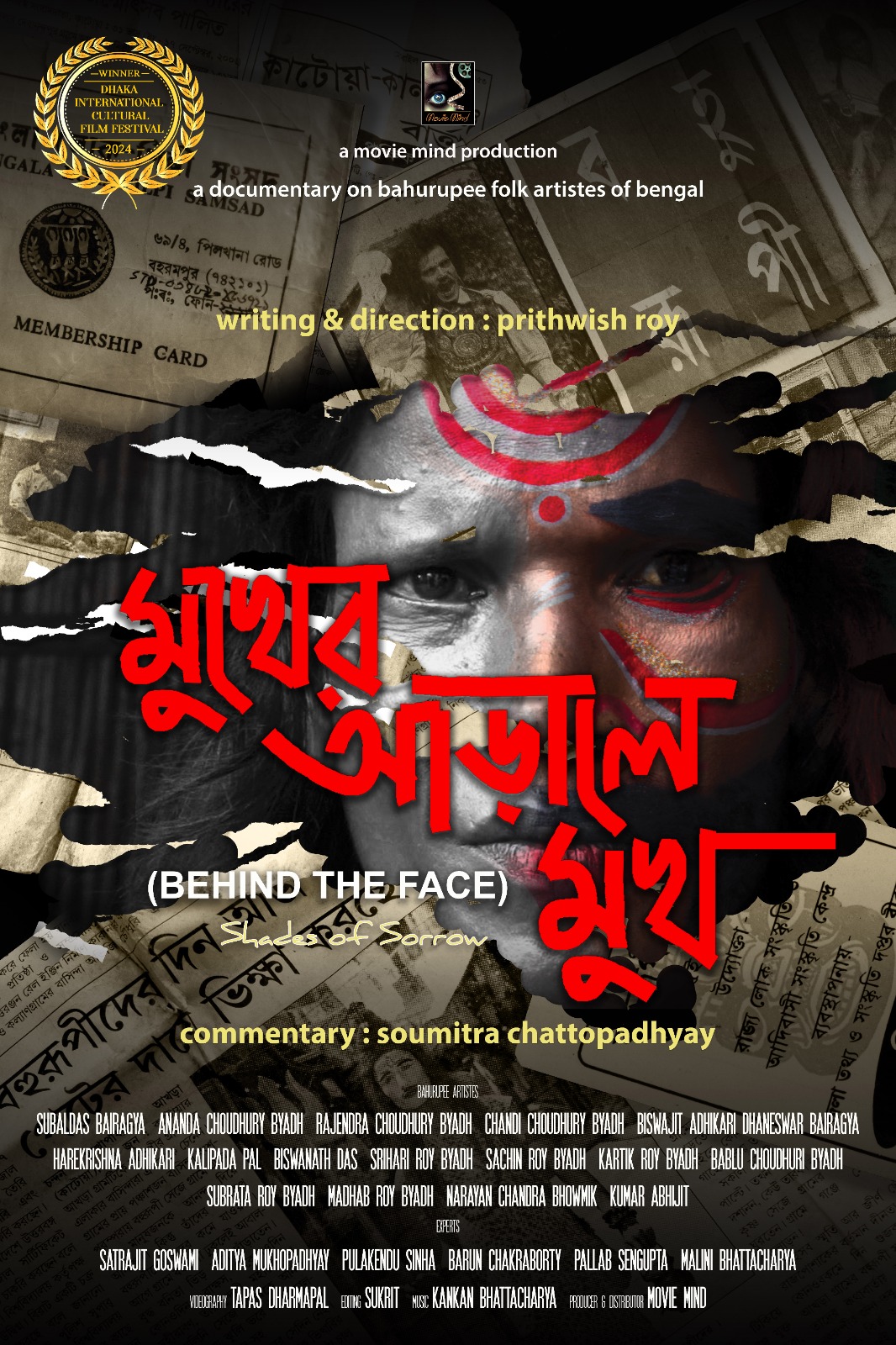
His first feature-length documentary is Mukher Arale Mukh aka Behind The Face.
Apart from stories and poems, his articles on film and theatre are also published in different magazines.
Director's Statement
I was merely a child then. One day I heard someone reciting unfamiliar and funny rhymes in the vicinity of our home. Suddenly I saw a person donning a queer outfit sitting tightly on a chair, but at the same time, I-don't-know-how, he was moving along. Obviously, I was quite astonished. I was told by the elders in our family that he was a Bahurupee artiste who took different guises for his livelihood.
As I was growing up, I engaged myself in the domain of theatre and also studied the history of drama. I came to know that drama takes its modern shape evolving from various folk-forms. But strangely the art of Bahurupee is not mentioned in any history of drama, although the Bahurupee performers also put on costumes and makeup, or impersonate a character by saying dialogues. And my own search started from that point.
I was so surprised to find that, in spite of a very long heritage spanning over 1500 years, the Bahurupee folk-form was not considered as an art until the end of the last century. This art-form could be once seen in various parts of India, but it is now constricted to a few states. This is true to my native state, West Bengal, also, where it once flourished most. Very few serious research-works exist on the history and present manifestation of this folk-form.
Since this art-form is dying gradually, it has become very difficult to locate the practitioners of Bahurupee. In fact, I had to travel to every nook and corner of my state to ferret them out.
I firmly believe that folk-culture is the heritage of any country as well as the sociological history of the common people.
So this documentary is made.