


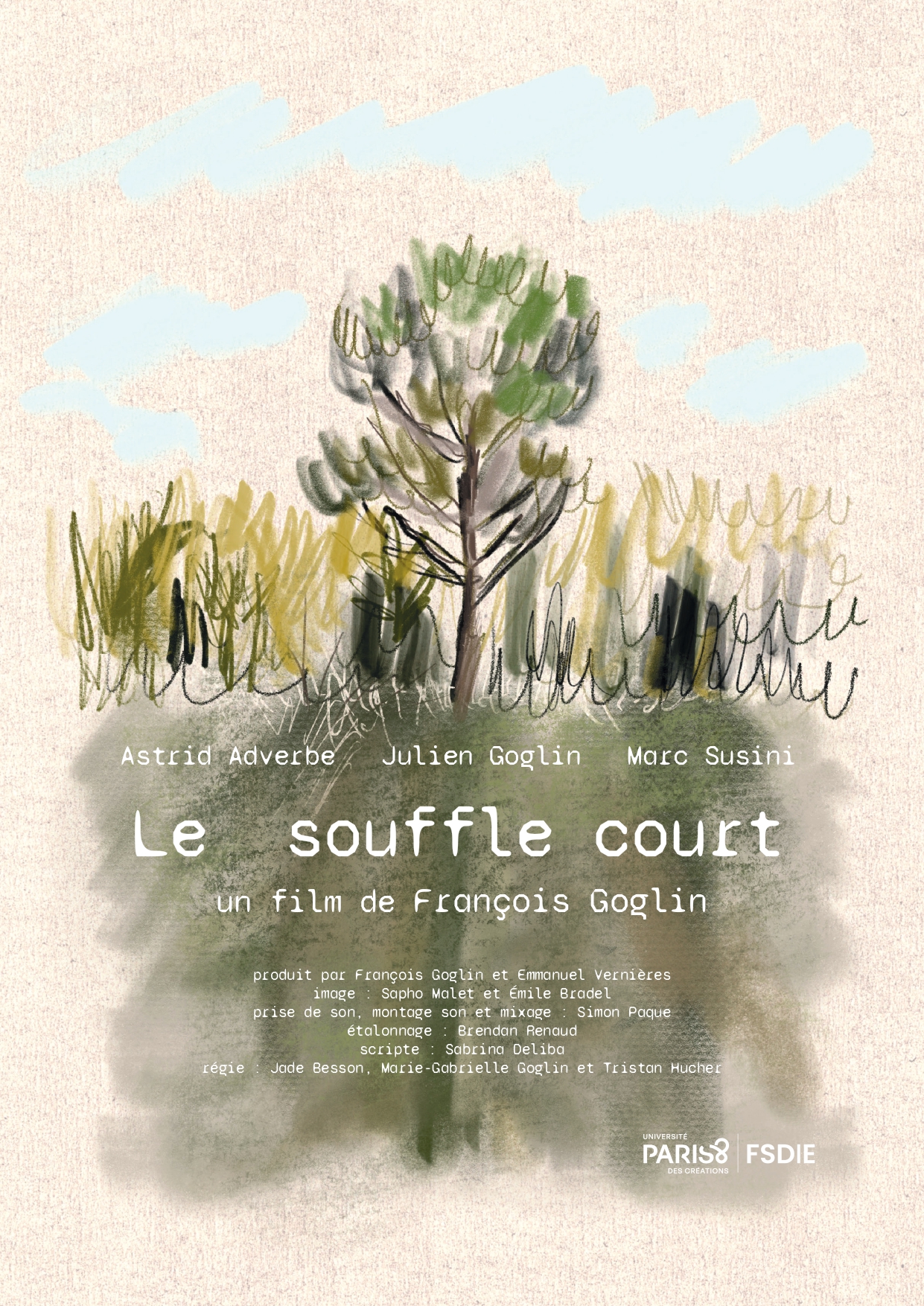




General Information
Duration: 27 min 52 sec
Genres: Fiction, Short, Student
Language:
Country:
Submitted By: François Goglin
Festival Rating 10.0
-
DirectorsFrançois Goglin
-
ProducersFrançois Goglin
-
ProducersEmmanuel Vernières
-
WritersFrançois Goglin
-
Director of photographySapho Malet
-
GafferEmile Bradel
-
Sound, editing et mixing soundSimon Paque
-
ColouristBrendan Renaud
-
Lead actorJulien Goglin
-
Lead actressAstrid AdverbeNuits blanches sur la jetée
-
Lead actorMarc SusiniThe Death of Louis XIV, Liberté, Pacifiction
-
Continuity scriptSabrina Deliba
-
Location managerJade Besson
-
Location managerMarie-Gabrielle Goglin
-
Location managerTristan Hucher
-
Film TypeFiction, Short, Student
-
Genres
-
Runtime27 minutes 52 seconds
-
Production BudgetUSD
-
Country of Origin
-
Country of Filming
-
Film Language
-
Shooting Format
-
Aspect Ratio
-
Film ColorColor
-
Student ProjectNo
-
First-time FilmmakerNo
Hainan Island International Film Festival
China
Sanya
12/07/2025
Asian Premiere
Official Selection
Detour Low-budget & Experimental Cinema
Portugal
Marinha Grande
11/07/2025
Portugese Premiere
Award winner
Director's Biography
Born in 2001 in Rouen, François Goglin works between visual arts and cinema, two disciplines that constantly inform and enrich each other in his creative process. He holds a Master’s degree in Directing and Creation from the University of Paris 8 Vincennes – Saint-Denis, where he developed a practice rooted in rhythm, materiality, the body, and the gaze.
Alongside his work as a filmmaker, he contributes as a film critic for Débordements, a French journal dedicated to contemporary cinematic forms. He also works as a production secretary at The Dark, an independent production company. His films explore the porous boundaries between gesture, silence, and landscape, always seeking to move beyond conventional narratives.
Director's Statement
This film was born from a place. It was conceived specifically for a unique house—timeless in its atmosphere, nestled in a lush, overgrown garden, the vegetation rising almost to the roof. That natural setting, both enclosed and abundant, was the starting point. A kind of primal stage where the landscape already carried a cinematic potential, where every corner seemed to hold a hidden narrative.
But the true impulse came from something even more personal: my younger brother’s gaze. He plays the main character. His expression—a blend of infinite melancholy and disarming simplicity—has always struck me. I’ve long wanted to film that gaze. Not as a performance, but as a presence. The entire film was shaped around it, less through traditional storytelling than through a series of fragments, ellipses, and moments designed to let something emerge—something honest, raw, and fragile.
The narrative is thus constructed in the hollows, in what is suggested rather than said. I sought strength in ellipses, reflection in form, focusing on bodies, their way of inhabiting space, of curling up against the ground or abandoning themselves to it. My camera doesn't observe from above. I wanted it to surround, to follow the contours, to breathe with them. I wanted us to see bodies lying in the grass, in a natural space that is small but open, paradoxically infinite.
It was important to me that the film be punctuated by this attention to gesture, to breath, to silence. I sought less to narrate than to convey a state—that of a being in the world, in a phase of upheaval. I wanted the emotion to flow there, in the interstices, sometimes in the discomfort, in this way of approaching childhood anguish and the disintegration of a family unit, without ever giving in to the expected codes of the coming-of-age story.
What my team and I sought to capture, in short, is a disturbance. Something shifting, fragile, physical. An in-between where cinema, by filming a look or a posture, can bring out raw emotion.